What a Kenyan work permit actually costs in 2026: Every fee, every class

2 November 2026By Peter Maina
In brief
- A Kenyan work permit carries two government payments, a non-refundable processing fee of KES 20,000 paid when the application is filed, and an annual issuance fee paid only on approval, ranging from KES 20,000 for approved religious work to KES 500,000 a year for the employment and investor classes.
- The full picture includes the people beside the applicant and the paper around them, a special pass at USD 200 (about KES 26,000) a month while the main application pends, a dependant’s pass at KES 10,000 for each spouse and child, and the registration every foreign resident completes on arrival.
- Citizens of the East African Community, the Democratic Republic of the Congo included, now pay nothing at all, because the Class R permit introduced in 2025 covers any approved activity free of charge.
Full Article
The first question a foreign professional or investor asks about Kenya is rarely about the law, it is about the money, and the answer is harder to find than it should be. The figures on the internet span a decade of superseded schedules, the official pages quote some fees and not others, and the applicant who budgets from the wrong year discovers the difference at the eFNS checkout. This article sets out the government cost of every work permit class as the Directorate of Immigration Services currently charges it, together with the passes that surround a permit, the costs the schedule does not mention, and the places where applicants lose money without receiving anything for it. The process itself, the classes, the documents and the common refusals, is covered in our guide to work permits and special passes in Kenya, which this article is built to sit beside. The figures below are the government’s charges as published at the date this article states, and because schedules change, the live eFNS invoice is always the final word.
The two payments, and when each falls due
Every permit application involves two distinct government payments, and the distinction does real budgeting work. The processing fee, KES 20,000 for most classes, is paid when the application is filed on the eFNS portal, and it is non-refundable, which is the quiet reason class selection matters so much, because an application made under the wrong class is rejected with the fee lost and the weeks gone. The issuance fee is the annual charge for the permit itself, and it falls due only on approval, so an applicant pays nothing beyond the processing fee unless and until the Directorate says yes. Where a permit is approved for two years, two years of issuance fees are paid, so a two-year Class D costs KES 1,020,000 all in, the KES 20,000 processing fee and KES 500,000 for each year. Some approvals, Class D in particular, also attach a security bond, which is set out in the approval notice and stands apart from the fees in the table.
The fee table
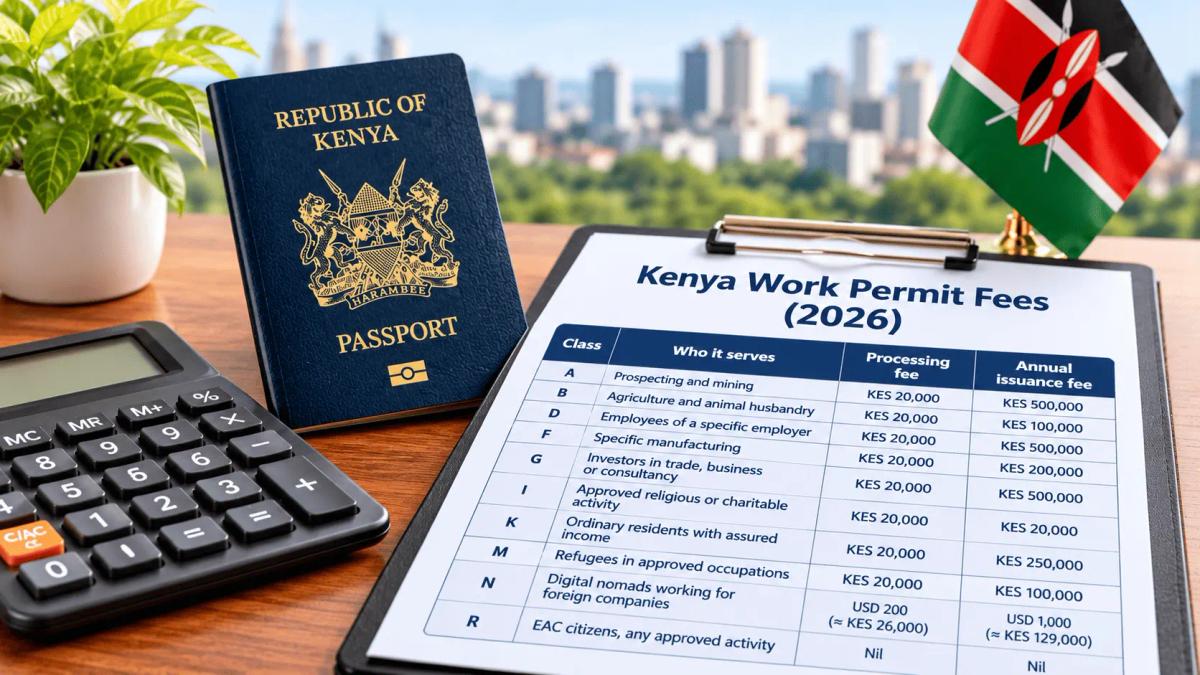
The classes and their current charges stand as follows, with the processing fee paid on application and the issuance fee on approval, per year.
| Class | Who it serves | Processing fee | Annual issuance fee |
| A | Prospecting and mining | KES 20,000 | KES 500,000 |
| B | Agriculture and animal husbandry | KES 20,000 | KES 100,000 |
| D | Employees of a specific employer | KES 20,000 | KES 500,000 |
| F | Specific manufacturing | KES 20,000 | KES 200,000 |
| G | Investors in trade, business or consultancy | KES 20,000 | KES 500,000 |
| I | Approved religious or charitable activity | KES 20,000 | KES 20,000 |
| K | Ordinary residents with assured income | KES 20,000 | KES 250,000 |
| M | Refugees in approved occupations | KES 20,000 | KES 100,000 |
| N | Digital nomads working for foreign companies | USD 200 (about KES 26,000) | USD 1,000 (about KES 129,000) |
| R | EAC citizens, any approved activity | Nil | Nil |
Class N fees are denominated in US dollars, with shilling equivalents at prevailing exchange rates. Class R, introduced in 2025, replaced the separate classes for citizens of Uganda, Tanzania, Rwanda, Burundi, South Sudan and the Democratic Republic of the Congo with one free permit covering employment, investment, trade and any other approved activity.
The passes and the people beside you
A permit holder rarely travels alone, and the family’s paperwork has its own price list. The special pass, the short-term authorisation that lawfully bridges the gap between arrival and an approved permit, costs USD 200 (about KES 26,000) for each month approved for non-EAC nationals, is free for EAC citizens, and is capped at six months in total, a ceiling the Directorate does not extend. The dependant’s pass, which lets a spouse and children reside in Kenya for as long as the principal permit runs, costs KES 10,000 per dependant, and it is worth repeating what it buys, residence only, since a spouse who wants to work needs a permit in their own right. Every foreign resident also registers for the foreign national certificate on arrival, commonly called the alien card, for which the Directorate’s own pages currently state different fees in different places, so that small amount is best confirmed on the live eFNS invoice rather than assumed. And the eTA a visitor arrives on costs little precisely because it authorises no work at all, a point the section below returns to.
What the fees do not include
The government schedule is only part of an honest budget. A Class D application needs the employer’s file and a credible Kenyan understudy plan, and assembling both has internal costs the schedule never sees. Certified copies, notarised translations for documents not in English, police clearance certificates from the home country and passport photographs to specification each cost something and take time. The Class G investor should keep two numbers firmly apart, the permit’s fees, which the table states, and the minimum capital of USD 100,000 (about KES 12.9 million) that must be shown in a Kenyan bank account, which is not a fee at all but the investment itself, staying the investor’s money throughout. Renewals repeat the issuance fee for each further year, so a permit is a subscription rather than a purchase, and a five-year plan should be budgeted as one. Professional fees for preparing and prosecuting the application are the one item wholly within the applicant’s control, and the test of any adviser is willingness to quote them, with the government charges and disbursements itemised, before being retained, which is how we quote.
Where applicants lose money
Three mistakes account for most of the money foreigners waste on Kenyan immigration. The first is the wrong class, the investor who applies under Class D or the employee under Class G, which ends in rejection with the processing fee lost and the clock restarted. The second is working without authorisation, on an eTA, on a visitor’s entry or beyond the scope of a special pass, which risks fines, removal and prosecution, and exposes the employer as well, costs that make every figure in the table look small. The third is the overrun special pass, renewed to its six-month ceiling with no substantive application filed behind it, leaving the holder unlawful with nothing in the pipeline. Each mistake is avoided the same way, by settling the right class first and filing the special pass and the substantive application in sequence, and for citizens of the EAC the happiest correction in this article applies, since a Congolese, Ugandan or Rwandan national needs none of the budgeting above, Class R being free, a subject our article on what EAC membership gives a Congolese worker or investor takes up in full.
What happens next
The figures above answer the first question, and the second, whether an application will actually succeed, is answered by preparation rather than payment. Our guide to work permits and special passes in Kenya walks the classes, documents and common refusals, and our articles on the Class G investor permit and on hiring a foreigner under Class D take the two biggest classes in depth. For an eligibility assessment and a full quotation, government charges, disbursements and our fees itemised, before any money is committed, the place to start is a conversation.
Frequently asked questions
How much does a Class D work permit cost in Kenya?
KES 20,000 in processing fees on application and KES 500,000 in issuance fees for each year approved, so a one-year permit costs KES 520,000 and a two-year approval KES 1,020,000, before any security bond stated in the approval notice. The processing fee is not refundable if the application fails.
Is the work permit processing fee refundable if I am refused?
No. The KES 20,000 processing fee is non-refundable whatever the outcome, which is why class selection and preparation matter, since an application under the wrong class is rejected with the fee lost.
What does the Class G investor permit cost?
KES 20,000 on application and KES 500,000 a year on approval. The minimum investment capital of USD 100,000 (about KES 12.9 million) shown in a Kenyan bank account is a separate requirement, and it is the investor’s own money put to work, not a fee paid to anyone.
Do EAC citizens pay for Kenyan work permits?
No. Under Class R, introduced in 2025, citizens of Uganda, Tanzania, Rwanda, Burundi, South Sudan and the Democratic Republic of the Congo receive a single permit covering employment, investment and any other approved activity free of charge, and their special passes are free as well.
What does a dependant’s pass cost, and can my spouse work on one?
KES 10,000 per dependant, covering residence for as long as the principal permit runs. It does not authorise employment, so a spouse who wants to work applies for a permit in their own right.
Peter Maina is a Partner of Peter Maina & Company Advocates. This article states the law as at 2 November 2026. It is general information, not legal advice. For an eligibility assessment and an itemised quotation for any permit or pass, reach out on e-mail peter@pmlaw.co.ke or WhatsApp +254 714 644 080.

Peter Maina
Peter Maina is an advocate of the High Court of Kenya and the founder of Peter Maina & Co Advocates, advising on Corporate and Commercial Law, Employment and Labour, Real Estate and Land, Banking and Finance, Capital Markets, Regulatory Compliance and Fintech, Corporate Governance, Private Wealth, Trusts & Estate Planning, and Dispute Resolution.
View Full Profile →Need Legal Assistance?
Whether you're dealing with corporate law, commercial disputes, or need professional legal advice, Peter Maina & Co Advocates is here to help.
How We Can HelpRelated Insights
View All Insights →
What it actually costs a foreign investor to set up in Kenya: the full table
In brief Full Article Every market entry we advise begins with the same request, one table with everything on it, because investors budget from totals and the figures for Kenya are scattered across a registrar, a revenue authority, forty-seven counties, a dozen regulators and an immigration directorate that each publish their own corner. This article […]
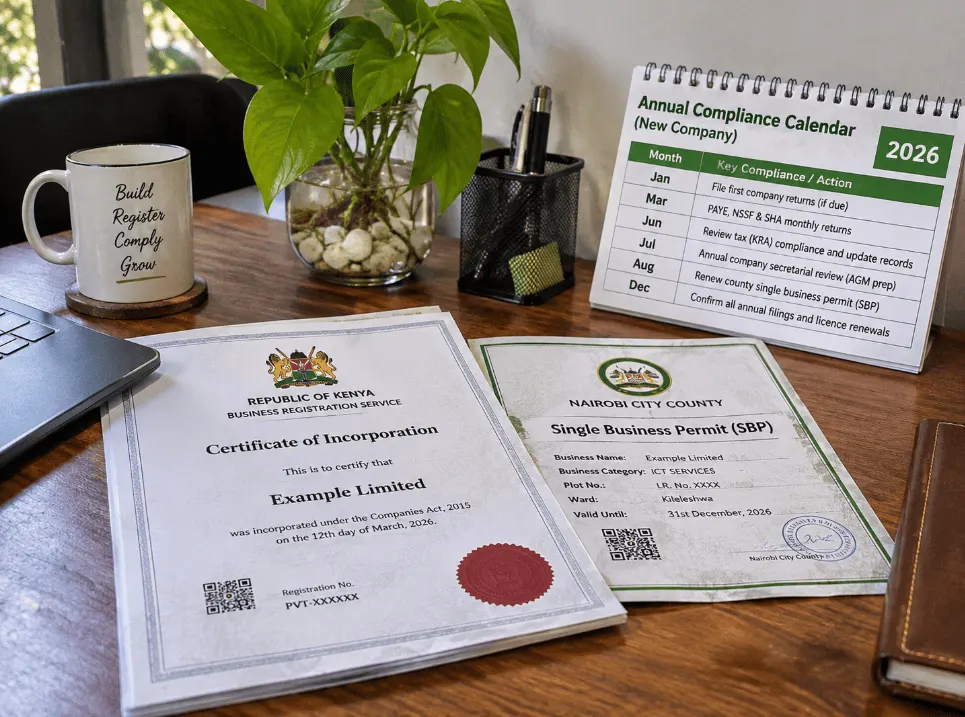
After incorporation: the licences, registrations and the compliance calendar
In brief Full Article The certificate of incorporation arrives by e-mail and feels like the finish line, and for the Registrar it is. For everyone else it is the starting gun. The bank wants more than the certificate, the first customer wants a compliant invoice, the county wants its permit before the doors open, and […]
How to register a company in Kenya as a foreigner, and what it costs
In brief Full Article Every foreign investor who approaches us begins with the same two questions, whether they are allowed to own the company and what the setting up will cost, and the honest answers are better than the folklore. Kenyan company law is open, the official fees are modest, and the registration is genuinely […]