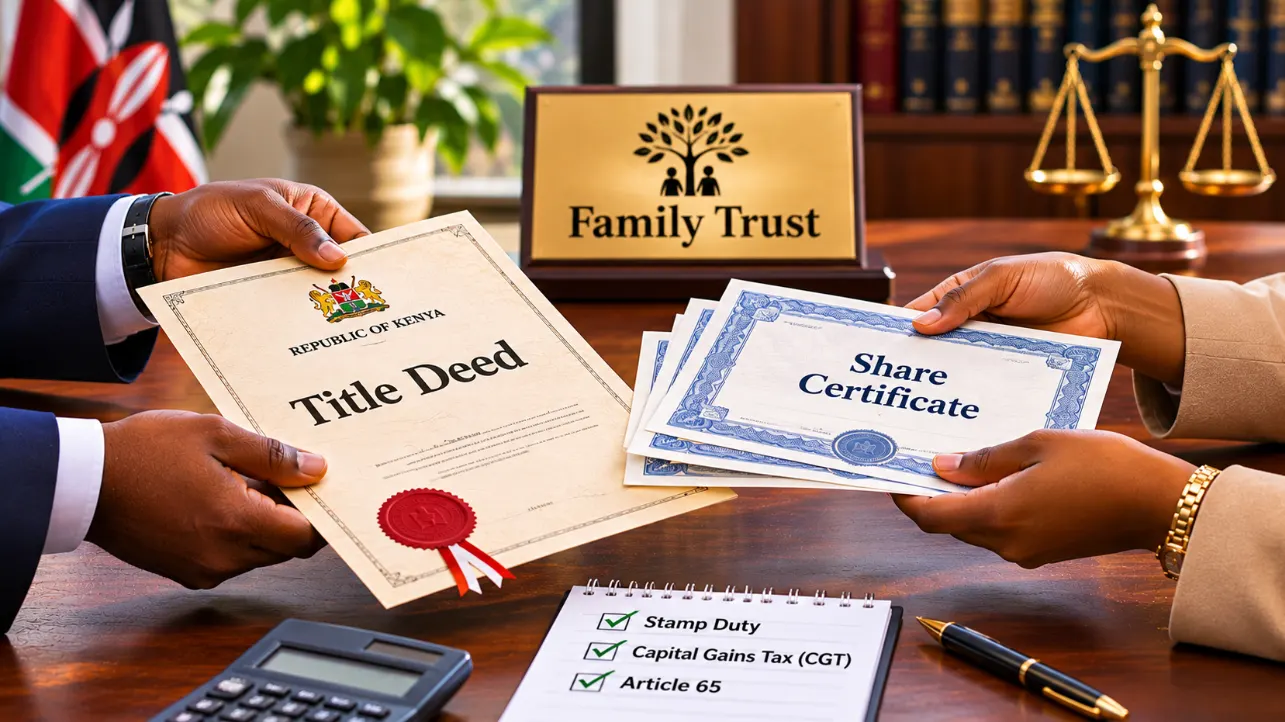
Putting land and family business shares into a trust: The mechanics that make it real

14 November 2026By Peter Maina
In brief
- A trust owns only what has actually been vested in it. The deed creates the structure, but until the land is transferred at the registry and the shares are entered in the company’s register of members, the trust is an empty vessel, and the estate planning it promised has not happened.
- Parliament cleared the road in. Transfers of property into a registered family trust attract no stamp duty and no capital gains tax, and distributions from the trustees to beneficiaries are relieved as well, so the costs of funding a trust are professional and procedural rather than fiscal.
- The Constitution draws one line through the design. Where a trust’s beneficial ownership is not wholly Kenyan, Article 65 treats it as non-citizen, and freehold land settled on it converts to a ninety-nine year leasehold, so the citizenship of trustees and beneficiaries is a design question to answer before the first title moves.
Full Article
The commonest failure in Kenyan trust planning is not a bad deed but an unfunded one. The family signs an elegant trust instrument, files it away with a sense of completion, and never carries out the transfers that would give the trust anything to hold, so that at the founder’s death the land is still registered in his name, the shares still sit on the register where they always sat, and the estate passes through probate exactly as if the trust had never existed. Funding is where a trust becomes real, and funding is conveyancing, with registries, consents, company registers and tax provisions to satisfy. This article walks the mechanics for the two assets Kenyan family trusts are actually built around, land and shares in the family company, together with the tax treatment that makes the journey cheap and the constitutional limit that shapes who can be in the trust at all. It closes the picture our articles on the family trust under the Trust Administration Act, 2026 and on choosing between a trust and a will began.
A trust owns only what is vested in it
Before anything moves, one structural question decides the paperwork. A trust that is registered but not incorporated has no legal personality, so its property is held by the trustees personally, as joint proprietors on the title and joint members in the company, with the register changing every time a trustee changes. A trust incorporated under the Trust Administration Act holds property in its own corporate name, which survives every change of trustee untouched, and for a trust built to hold titles across generations that convenience is usually worth the incorporation. Either way, the discipline is the one this series has pressed from its first article, that ownership lives in the registers, not in the recitals, and the funding exercise is complete only when a search at the lands registry and an inspection of the company’s register of members both show the trust, or its trustees, where the founder used to be.
Moving land
Land moves into a trust by an ordinary registered transfer, from the settlor to the incorporated trust or to the trustees, and the ordinary conveyancing disciplines apply with full force. The title is searched and its encumbrances cleared or disclosed, because a charged property moves only with the lender’s consent. Agricultural land within the land control regime needs the Land Control Board’s consent to the transaction. The matrimonial home moves only with the other spouse’s consent, for the reasons our article on choosing between a trust and a will sets out, and a settlor minded to settle the family home should treat that conversation as part of the design rather than an obstacle to it. What the transfer does not attract is the usual taxes. A voluntary disposition into a registered family trust is exempt from stamp duty under section 52(2)(b) of the Stamp Duty Act [link], and the Income Tax Act’s First Schedule exempts the transfer from capital gains tax, so the journey in costs registry fees, valuations where needed and professional charges, not a percentage of the land’s value. The documents of the trust should then follow the land, with the asset entered in the trust’s schedule and records, so the deed, the register and the registry tell one story.
The Article 65 question
The Constitution does not care that a structure is called a family trust, it asks who ultimately owns it. Under Article 65, a non-citizen may hold land only on leasehold of at most ninety-nine years, a body corporate is a citizen only if wholly owned by citizens, and property held in trust is looked through to its beneficial ownership, so a trust with a non-citizen trustee or beneficiaries who are not Kenyan takes freehold land as a ninety-nine year lease however Kenyan the settlor. For most families this is no obstacle, and for families with members abroad it is usually solved by facts rather than exclusion, because a Kenyan citizen by birth who has taken another passport remains a citizen, as our article on dual citizenship and the order of operations explains, and the relative who lost citizenship by naturalising before 2010 can regain it before the trust is funded. What the Article punishes is inattention, the American son-in-law added to the beneficiary class for warmth, the foreign professional trustee appointed for prestige, each quietly converting the family’s freehold. The design rule is simple to state, settle freehold land on trusts whose beneficial ownership is wholly Kenyan, deal with non-citizen family through interests that do not offend the Article, and take advice before, not after, the class is written.
Moving the family company’s shares
Shares move by instrument of transfer, and the company’s own constitution governs the road. The articles and any shareholders’ agreement are checked first, because pre-emption rights, consent requirements and transfer restrictions bind the settlor like any other transferring shareholder, and a transfer made in breach of them is a dispute, the lesson of our article on governing the family business. The board approves and registers the transfer, the register of members is written up, and the company’s beneficial ownership filings are then updated, since the trust now stands behind the shareholding and the register the company files must disclose the natural persons behind the trust, the same transparency our article on what existing trusts must do under the new law describes from the trust’s side. The tax treatment mirrors the land, with the transfer into the registered family trust exempt from capital gains tax and stamp duty, and the practical questions are corporate rather than fiscal, whether the trustees should hold a controlling block or a protected minority, how the trust’s votes will be exercised and by whom, and how dividends flow through the deed to the family. Done properly, the company acquires its most stable shareholder, one that does not die, divorce or emigrate, which is much of the point.
Running the funded trust
Funding changes the trust from a document into an operation. The rent and dividends now belong to the trusteeship and are taxed under the Income Tax Act’s machinery for trust income, the trustees keep the accounts, minutes and registers the Trust Administration Act requires, and distributions follow the deed, with the road out relieved as the road in was, since transfers from trustees to entitled beneficiaries are exempt from stamp duty and excluded from capital gains tax. The maintenance discipline is modest and permanent, every later asset settled by the same formal steps, every change of trustee carried through to titles and registers, the beneficial ownership records kept current, and the will drafted to sweep whatever the trust was never given, so the two instruments close around the estate together. A family that keeps this rhythm has done something quietly substantial, moved its permanent assets beyond the reach of probate, succession disputes and individual mortality, while keeping every shilling of value inside the family.
What happens next
This article closes our run on wills, trusts and estates, which runs from how to write a valid will in Kenya through the family trust, the choice between the instruments, the compliance owed by existing trusts, and the probate process and its costs. For a trust you want funded properly, titles moved, shares transferred and the registers aligned, the place to start is a conversation.
Frequently asked questions
Do I pay stamp duty or capital gains tax when I transfer land into a family trust?
No. A transfer of property into a registered family trust is exempt from stamp duty under section 52(2)(b) of the Stamp Duty Act and from capital gains tax under the Income Tax Act’s First Schedule exemptions. The costs of funding a trust are registry fees, any valuations and professional charges, not transfer taxes.
Can a family trust hold freehold land if some beneficiaries are foreign citizens?
Not as freehold. Article 65 of the Constitution looks through a trust to its beneficial ownership, and where that ownership is not wholly Kenyan the trust holds land as a non-citizen, on leasehold of at most ninety-nine years. Dual citizens by birth remain citizens and do not trigger the limit, and the beneficiary class should be designed with the Article in view before land is settled.
How are shares in a family company transferred into a trust?
By instrument of transfer, made in compliance with the pre-emption and consent provisions of the company’s articles and any shareholders’ agreement, approved by the board, entered in the register of members and reflected in the company’s beneficial ownership filings. The transfer into a registered family trust is exempt from stamp duty and capital gains tax.
Can I put the matrimonial home into a trust?
Only with your spouse’s consent, because the Matrimonial Property Act protects a spouse’s rights in matrimonial property and dispositions of the home require spousal consent. In practice the home is settled, if at all, by both spouses together as part of a plan both have signed.
What happens to the rent and dividends after the assets move?
They belong to the trusteeship and are applied as the deed directs, with the income taxed under the Income Tax Act’s rules for trust income. Distributions to entitled beneficiaries are relieved on the way out, exempt from stamp duty and excluded from capital gains tax, so the reliefs cover the family road in and the family road out.
Peter Maina is a Partner of Peter Maina & Company Advocates. This article states the law as at 14 November 2026. It is general information, not legal advice. To have land and shares moved into a trust with the titles, registers and consents done properly, reach out on e-mail peter@pmlaw.co.ke or WhatsApp +254 714 644 080.

Peter Maina
Peter Maina is an advocate of the High Court of Kenya and the founder of Peter Maina & Co Advocates, advising on Corporate and Commercial Law, Employment and Labour, Real Estate and Land, Banking and Finance, Capital Markets, Regulatory Compliance and Fintech, Corporate Governance, Private Wealth, Trusts & Estate Planning, and Dispute Resolution.
View Full Profile →Need Legal Assistance?
Whether you're dealing with corporate law, commercial disputes, or need professional legal advice, Peter Maina & Co Advocates is here to help.
How We Can HelpRelated Insights
View All Insights →
Grants of probate and letters of administration in Kenya: The process, and what it costs
In brief Full Article When someone dies, their property enters a legal pause. Bank accounts freeze, land cannot move and shares cannot be sold, because the law vests a dead person’s free property in no one until the High Court, or a magistrate’s court within its limits, appoints someone to administer it. The appointment is […]
The old trust under the new law: What existing Kenyan trusts must do before the deadline
In brief Full Article Kenya has thousands of trusts formed under laws that no longer exist, family trusts and charitable foundations incorporated under the Trustees (Perpetual Succession) Act, settlements governed by the Trustee Act of 1929, and deeds lodged under the Registration of Documents Act because nothing better was available. On 25 September 2026 all […]
Trust or will? Choosing the right instrument for a Kenyan estate
In brief Full Article The question arrives at our desk in one form or another every week. Should I write a will, or should I set up a trust? It is asked as though the two were rivals, and the comparison industry online treats them that way, usually ending in whichever instrument the writer happens […]