
The family trust under the Trust Administration Act, 2026: Who needs one, and how it is set up

10 November 2026By Peter Maina
In brief
- Kenya rewrote its trust law in 2026. The Trust Administration Act, in force since 25 September 2026, repealed the colonial-era Trustee Act and the Trustees (Perpetual Succession) Act and placed every written trust under one Registrar of Trusts, with the blunt consequence that a written trust which is neither registered nor incorporated is unenforceable.
- For families, the trust remains the one instrument that holds land and company shares together across generations, passes them outside the probate process, and does so with reliefs Parliament built deliberately, no stamp duty and no capital gains tax on moving property into a registered family trust.
- Registration itself is in a holding pattern. The Registrar suspended new applications on 3 November 2026 pending new regulations, which also carry the fee schedule, so the present work is preparation, the deed settled, the records built and the beneficial ownership register ready for the moment the window reopens.
Full Article
Every family of property eventually meets the limits of the will. A will speaks once, at death, distributes what its maker held personally, and sends the whole of it through probate, and for a family whose wealth is a farm that must not be subdivided, a company that must not be scattered among heirs, or children whose inheritance needs managing rather than handing over, those limits are the problem itself. The family trust answers it. Property is moved during the settlor’s lifetime into the hands of trustees, who hold and manage it under a deed for the named beneficiaries, so that the settlor’s death changes nothing about the ownership, the management or the plan. This article explains what the Trust Administration Act, 2026 made of the family trust, who actually needs one, what moving property into one costs and does not cost, and how one is set up and registered, including the honest position on where registration stands at the date this article carries. It is written for the founder with land and shares to protect, the family weighing a trust against a will, and the trustees of older trusts wondering what the new law asks of them.
What a family trust is, and what the 2026 Act changed
A trust separates the management of property from its enjoyment. The settlor transfers assets to trustees, the trustees hold and administer them under the terms of a trust deed, and the beneficiaries, usually the settlor’s family and often the settlor too, take the benefit as the deed directs. The Trust Administration Act, 2026 [link], assented to on 8 September 2026 and in force since 25 September 2026, took this old architecture and gave it a modern registry. It repealed both the Trustee Act and the Trustees (Perpetual Succession) Act, placed all written trusts under a Registrar of Trusts within the Business Registration Service, and drew a line that matters more than any other in the new law. A written trust must be registered, which gives it a unique identification number and makes it enforceable, or incorporated, which goes further and gives the trustees a corporate body with perpetual succession that can hold title in its own name, and a written trust that is neither is unenforceable, subject only to a petition to the court. A family trust sits comfortably in this scheme, and the Act treats it gently in one respect, since a family trust may operate with a single trustee where charitable and purpose trusts need more, and a licensed trust agent may provide its registered office.
Who actually needs one
The honest answer is not everyone, and the cases where a trust earns its keep are recognisable. The first is indivisible property, the farm, the plot with the family home, the building whose rent educates grandchildren, assets that a will would eventually scatter among heirs in shares nobody can live on, and that a trust holds whole while distributing the benefit. The second is the family company, where shares bequeathed by will arrive in the hands of a committee of heirs with equal votes and unequal interest, the problem our article on governing the family business examines, and where shares settled on trust are voted by trustees under one coherent policy. The third is the beneficiary who cannot yet, or will never, manage property, the minor children, the relative with a disability, the young adult for whom an inheritance at twenty-two would be a misfortune. The fourth is continuity itself, because trust assets do not pass through the succession process at all, which spares the family the timelines our article on how to write a valid will in Kenya describes, and keeps the estate’s engine running while any probate of the residue proceeds. And the fifth, valued more every year, is privacy and protection, since property settled on trust before trouble arrives is no longer the settlor’s to lose, within the limits the law places on transfers meant to defeat creditors. How a trust compares with a will, and when a family needs both, is the subject of our companion article on choosing between the two.
The money, stated plainly
Parliament wanted family trusts used, and said so in the tax statutes. A transfer of property into a registered family trust attracts no stamp duty, under section 52(2)(b) of the Stamp Duty Act, and no capital gains tax, under the exemptions in the First Schedule to the Income Tax Act covering transfers of immovable property and of other property including shares into a registered family trust. The principal sum settled on a registered family trust is itself exempt from income tax, and when the trustees in due course transfer property to a beneficiary who has become entitled, that transfer is relieved as well, both for capital gains and for stamp duty. The reliefs are for the family road in and the family road out, and they stop where the family ends, so a sale by the trustees to a third party is taxed like any other sale, and the income the trust property earns, the rent, the dividends, the interest, is taxed through the machinery that treats it as income of the trustee or of the beneficiaries who receive it. A family trust is a succession instrument with deliberate tax reliefs, not a tax shelter, and families who approach it as the former are the ones the structure rewards. As for official fees, none are currently gazetted, because the fee schedule arrives with the regulations discussed below, and any figure quoted today is a guess. What a family should budget for now is the professional work, the design of the deed, the conveyancing of the assets into the trust and the registration formalities when the window reopens.
Registration, and where it stands
The Act contemplates a straightforward sequence, the deed executed, the application lodged with the Registrar of Trusts, registration with a unique identification number or incorporation where legal personality is wanted, and thereafter a living compliance relationship, a register of beneficial owners kept and lodged, changes notified within twenty-one days, records kept for seven years and an annual return filed within thirty days of each anniversary. The present reality needs stating with equal clarity. On 3 November 2026 the Business Registration Service suspended the lodging of new trust applications through its manual platform with immediate effect, retired the old Form TR1 inherited from the repealed law, and published draft Trust Administration Regulations for public participation, with written comments invited up to 20 November 2026. The draft regulations carry the forms, the fees, the electronic lodgement system and a licensing regime for professional trust companies, which as proposed would need KES 5 million in capital, a KES 10 million performance bond and KES 50 million in professional indemnity cover. For a family setting up now, the suspension changes the order of work rather than the decision, since everything except the lodgement can and should be done in the interim, and a trust whose deed, asset schedule and beneficial ownership records are ready will register in days once the system opens. Trusts that existed under the old law stand in a different position, transitioned automatically with twenty-four months from commencement to reach full compliance, and what that compliance involves is the subject of our companion article on the old trust under the new law.
Setting one up properly
The deed is where family trusts succeed or fail, and the drafting decisions are few but weighty. The beneficiaries are defined as a class or named, with the flexibility the family actually wants rather than the widest words the precedent offered. The trustees are chosen for competence and longevity, with the mechanism for replacing them written down, because a trust whose last trustee has died without a succession clause is a problem the court must solve. The powers of investment, distribution and amendment are set to the family’s intentions, and a letter of wishes, informal but invaluable, tells the trustees how the settlor hoped the discretion would be exercised. The assets are then moved in properly, the land by registered transfer to the trustees or the incorporated trust, the shares by instrument of transfer entered in the company’s register of members, because a trust owns only what the documents say it owns, the same discipline every article in this series keeps returning to. Families who want professional administration can appoint a corporate trustee alongside or instead of relatives, with the licensing regime above in view, and families with members abroad should read this article beside our article on succession for Kenyans overseas, since a trust is often the cleanest answer to a cross-border estate.
What happens next
The regulations now in public participation will set the forms and fees and reopen registration, and the firm is following them through to gazettement. For a family weighing a trust, the present moment is for design, the deed drafted, the assets scheduled, the records prepared, so that registration is a formality rather than a project. The place to start is a conversation.
Frequently asked questions
What is a registered family trust in Kenya?
A trust created by a written deed for the benefit of a settlor’s family and registered with the Registrar of Trusts under the Trust Administration Act, 2026. Registration gives the trust a unique identification number and makes it enforceable, and incorporation goes further, giving the trustees a corporate body that holds title in its own name.
What are the benefits of a family trust?
Trust assets pass outside probate, so the family’s land and company shares are held and managed without interruption at the settlor’s death. The structure keeps indivisible property whole, provides for minors and vulnerable beneficiaries through managed distributions, and enjoys deliberate tax reliefs on the way in and on distributions to beneficiaries.
Can I register a family trust right now?
Not at the moment of writing. The Registrar suspended new applications on 3 November 2026 pending new regulations, which will also carry the fee schedule. Everything short of lodgement can proceed, the deed, the asset schedule and the beneficial ownership records, so the trust registers promptly once the system reopens.
Do I pay tax when I put property into a family trust?
No stamp duty and no capital gains tax apply to transfers of property into a registered family trust, under section 52(2)(b) of the Stamp Duty Act and the exemptions in the First Schedule to the Income Tax Act, and the principal sum settled is exempt from income tax. Income the trust property earns thereafter is taxed in the ordinary way, and sales to third parties enjoy no relief.
How many trustees does a family trust need?
One is enough under the Trust Administration Act, though most families appoint two or three with a written mechanism for succession. A licensed corporate trustee can serve alongside or instead of family members where professional administration is wanted.
Peter Maina is a Partner of Peter Maina & Company Advocates. This article states the law as at 10 November 2026. It is general information, not legal advice. To design a family trust, prepare it for registration or move property into one, reach out on e-mail peter@pmlaw.co.ke or WhatsApp +254 714 644 080.

Peter Maina
Peter Maina is an advocate of the High Court of Kenya and the founder of Peter Maina & Co Advocates, advising on Corporate and Commercial Law, Employment and Labour, Real Estate and Land, Banking and Finance, Capital Markets, Regulatory Compliance and Fintech, Corporate Governance, Private Wealth, Trusts & Estate Planning, and Dispute Resolution.
View Full Profile →Need Legal Assistance?
Whether you're dealing with corporate law, commercial disputes, or need professional legal advice, Peter Maina & Co Advocates is here to help.
How We Can HelpRelated Insights
View All Insights →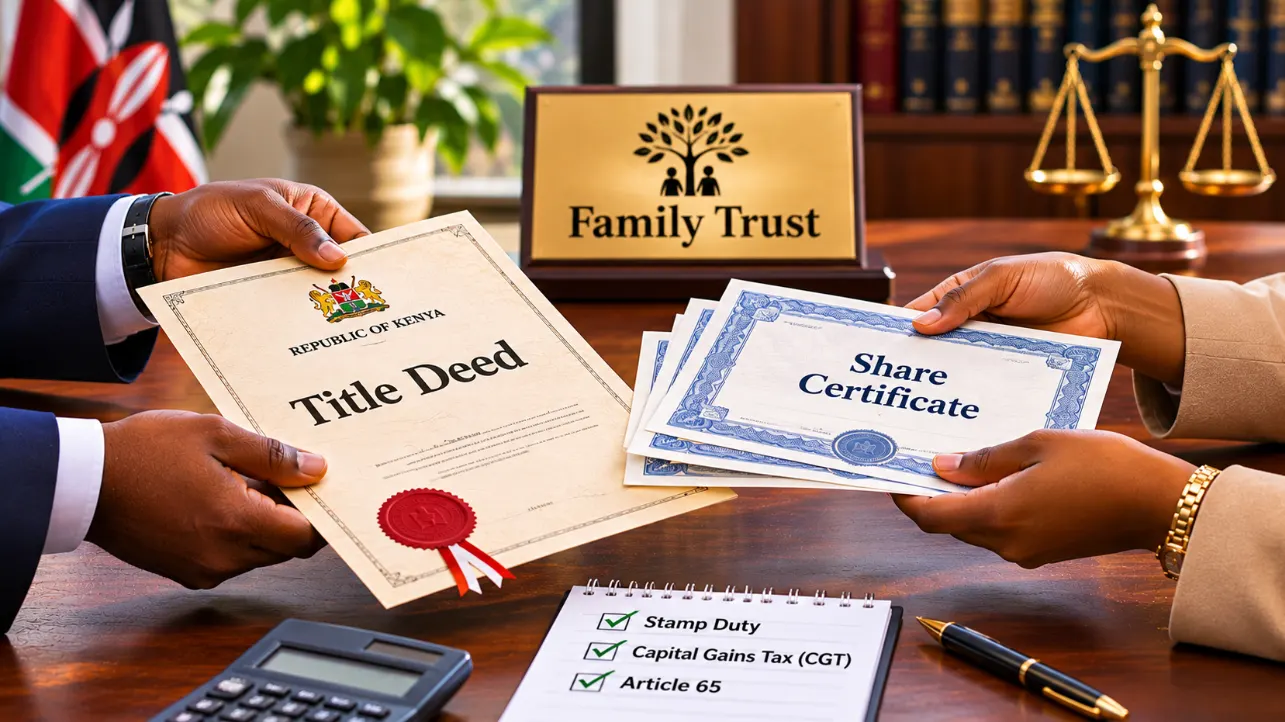
Putting land and family business shares into a trust: The mechanics that make it real
In brief Full Article The commonest failure in Kenyan trust planning is not a bad deed but an unfunded one. The family signs an elegant trust instrument, files it away with a sense of completion, and never carries out the transfers that would give the trust anything to hold, so that at the founder’s death […]

Grants of probate and letters of administration in Kenya: The process, and what it costs
In brief Full Article When someone dies, their property enters a legal pause. Bank accounts freeze, land cannot move and shares cannot be sold, because the law vests a dead person’s free property in no one until the High Court, or a magistrate’s court within its limits, appoints someone to administer it. The appointment is […]
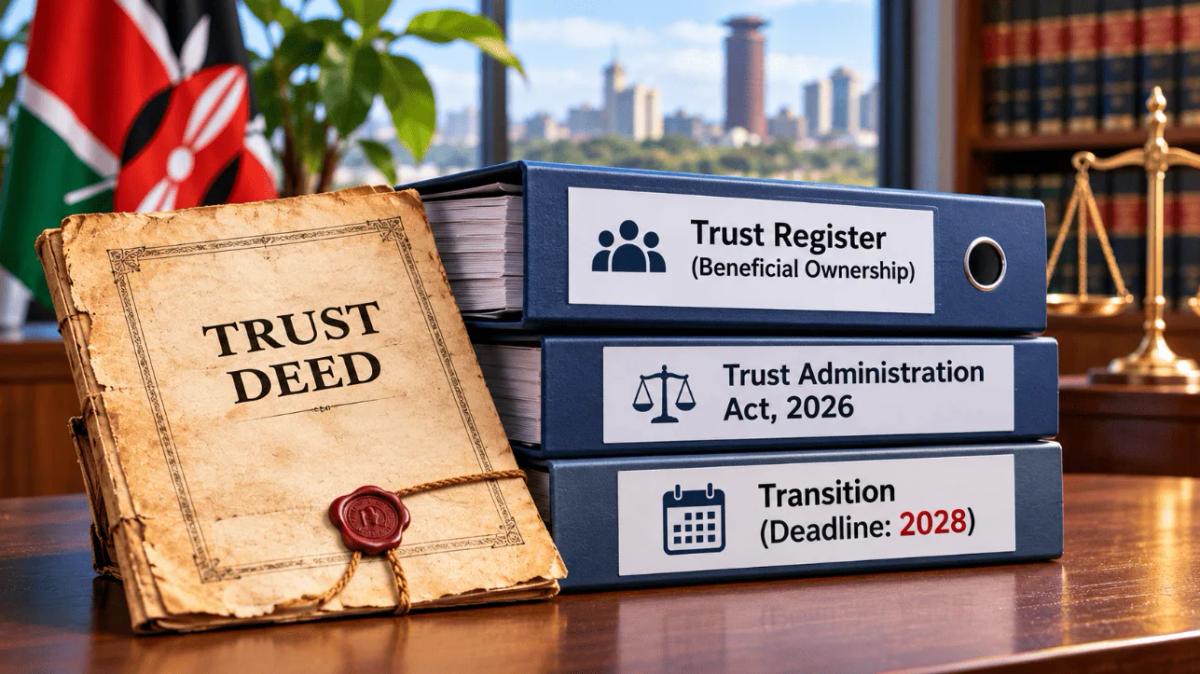
The old trust under the new law: What existing Kenyan trusts must do before the deadline
In brief Full Article Kenya has thousands of trusts formed under laws that no longer exist, family trusts and charitable foundations incorporated under the Trustees (Perpetual Succession) Act, settlements governed by the Trustee Act of 1929, and deeds lodged under the Registration of Documents Act because nothing better was available. On 25 September 2026 all […]