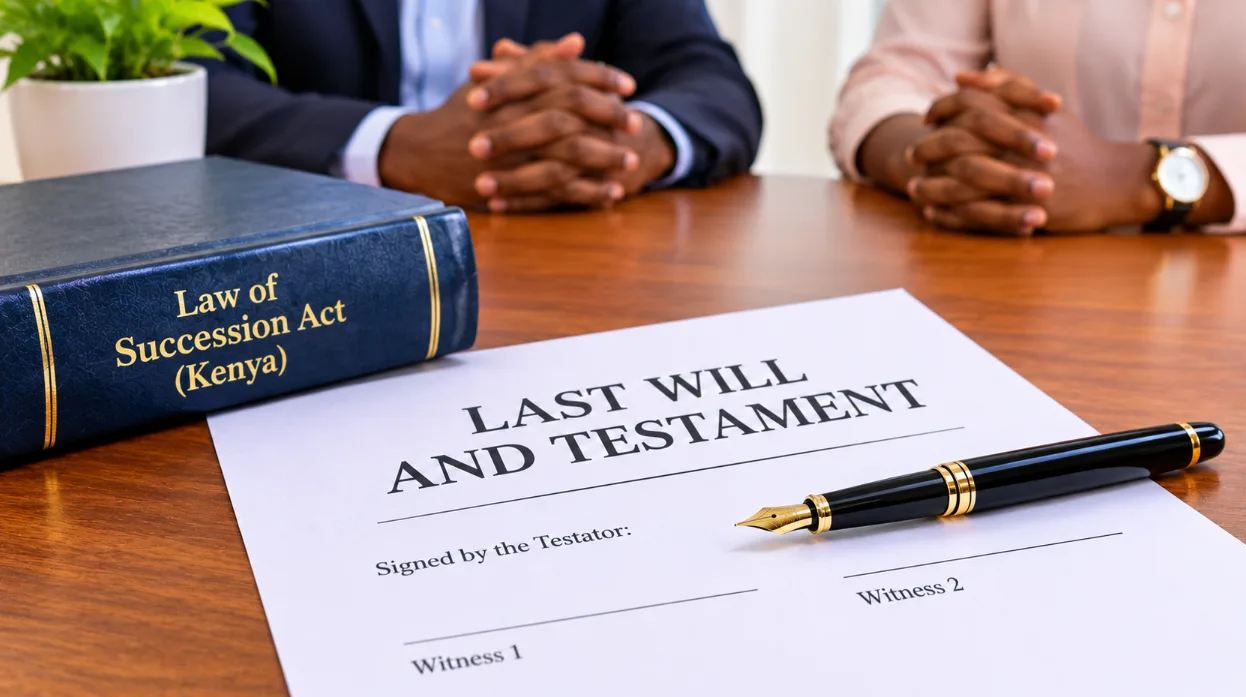
How to write a valid will in Kenya: What the law requires, and why a template fails

9 November 2026By Peter Maina
In brief
- Any adult of sound mind can make a valid will in Kenya. The Law of Succession Act asks for surprisingly little, writing, a signature and two competent witnesses, and nothing about a valid will requires a registry, a stamp or a ceremony. What it does require is precision, and precision is exactly what the downloaded template cannot supply.
- The commonest fatal errors are quiet ones. A beneficiary or a beneficiary’s spouse witnesses the will and the gift to them is void. The assets are described from memory rather than from the title and the register. And the maker marries, which revokes the will entirely unless it was made in contemplation of that marriage.
- A will is a document under maintenance, not an event. It should be reviewed on marriage, divorce, births, major purchases and the death of an executor, it cannot simply write out the people the law calls dependants, and its original belongs in safe custody with the executor told where.
Full Article
Most Kenyans of property die without a will, and the reason is rarely conviction. It is postponement, helped along by the belief that making a will is an elaborate, expensive or morbid affair. The law takes the opposite view. The Law of Succession Act [link] lets any adult of sound mind dispose of their property by a written document that can be prepared in an afternoon, and the presumption of sound mind stands unless whoever challenges the will proves otherwise. What the Act will not forgive is imprecision at three points, the signature, the witnesses and the words that actually carry the estate, and these are the points at which the free template downloaded the night before fails. This article sets out what a valid Kenyan will must contain, how it is signed and witnessed, why templates and borrowed forms go wrong, and how a will is kept alive once made. It is written for the person making a first will, the family prompted by a loss to put their own affairs in order, and the owner of land and company shares whose estate deserves better than a form.
Who can make a will, and what counts as one
Capacity is generous. Under section 5 of the Act, every person of sound mind who is not a minor may dispose of all of their free property by will, a married woman exactly as any man, and the law presumes soundness of mind, placing the burden of proving otherwise on whoever alleges it. Kenyan law also recognises the oral will, but on terms that make it a poor plan. An oral will requires two or more competent witnesses and lapses unless the maker dies within three months of making it, and it gives way to any written will it contradicts. For everyone outside its narrow emergencies, the written will is the instrument, and the rest of this article concerns the written will alone.
What a will that works actually contains
Strip away the legal dress and a sound will does six jobs. It identifies its maker and revokes all earlier wills, so that only one document speaks at death. It appoints executors, the people who will obtain probate and administer the estate, named deliberately and with at least one substitute, because an executor who has died or emigrated is the commonest cause of a stalled estate. It makes the specific gifts, and makes them from the documents rather than from memory, the parcel by its title number as the register states it, the shares by the company’s exact name and the shareholding the register of members actually records, because a will can only give what its maker holds on paper, a lesson our article on governing the family business teaches from the company’s side. It appoints guardians where there are minor children. It disposes of the residue, the catch-all clause that carries everything not specifically given, including assets acquired after the will was signed, and the absence of a residuary clause is the single most expensive omission in home-made wills, since whatever falls outside the listed gifts passes as if there were no will at all. And it closes with the attestation, the signing block for maker and witnesses, drawn so that the execution the law requires is visible on the face of the document.
Signing it, which is where wills live or die
Section 11 of the Act states the whole of the formality. The will must be in writing. The maker must sign it, or acknowledge a signature made on their behalf, placed so that it appears intended to give effect to the document. And it must be attested by two or more competent witnesses, each of whom saw the signature made or acknowledged and then signed in the maker’s presence, though the witnesses need not be present at the same time. The trap sits in section 13. The will remains valid if a beneficiary witnesses it, but the gift to that witness, or to the witness’s spouse, is void unless the will was attested by at least two additional independent witnesses. Families fall into this constantly, because the people most likely to be in the room at a signing are precisely the people the will benefits. The clean practice is simple. The witnesses are two adults who take nothing under the will and are married to no one who does, colleagues and neighbours serve perfectly, and the executor may witness, since the Act expressly preserves an executor’s competence as a witness. No advocate, notary or registrar is required for validity, though the attesting witnesses may later be needed to prove execution at probate, which is a reason to choose witnesses who can be found again.
Why the downloaded template fails
The template promises the form of a will, and the form is the one part that was never the problem. What it cannot do is the matching of document to estate that makes a will operate. Templates drafted for other jurisdictions import concepts Kenyan law does not use, notarisation that adds nothing, community property that does not exist here, living trust language that creates nothing. Templates invite the maker to describe assets in conversational terms, the plot in Kitengela, my shares in the family company, descriptions a registry cannot act on and a disappointed relative can litigate about, and they have no way of warning that the land bought through a brother and still registered in his name is not, on the register, the maker’s to give, the problem our article on land held through family examines. They say nothing about section 13, so the son who inherits the house signs as a witness and voids his own gift. They say nothing about section 19, so the will made before a marriage is revoked by it and nobody learns this until the probate registry does. And they produce a document with no custody plan, one print-out in a drawer, discoverable by anyone and findable by no one. None of this is an argument that only lawyers may write wills, since the law says otherwise. It is an argument that a will is advice in the form of a document, and a form without the advice does the estate little good.
Keeping the will alive
A will speaks from death, which means it must survive the life in between. The maker may revoke or alter it at any time, by a later will or codicil or by destroying it with that intention, and the discipline is to do so deliberately rather than by accident. The sharpest rule is section 19. Marriage revokes a will, entirely and automatically, unless the will was expressed to be made in contemplation of marriage with the named person, so the will made in bachelorhood dies silently at the wedding. Divorce, by contrast, revokes nothing, and the gift to a former spouse stands until the will is changed, which surprises people in the other direction. Beyond these, the review triggers are ordinary life, births, significant purchases and sales, the death or emigration of an executor or guardian, and a change in the shape of the family business. One boundary deserves honest statement. Under section 26, a spouse, children and certain maintained relatives are dependants, and a dependant for whom the will makes no reasonable provision may ask the court to order provision out of the estate, so a will written to punish is an invitation to litigation rather than a settlement of affairs, and disinheritance is a matter for advice, not defiance. Finally, custody. A will needs no registration and attracts no tax, but the original must be producible at probate, so it belongs in an advocate’s strongroom or a bank, with the executor told where it is, and where the maker or the assets sit outside Kenya, our article on succession for Kenyans overseas carries the cross-border half of the subject.
What happens next
A will is one instrument in a larger box. For families whose holdings have outgrown a simple bequest, the registered family trust under the Trust Administration Act, 2026 holds property together across generations in a way a will cannot, and choosing between the two, or combining them, is the estate planner’s real work. To have a will drawn or reviewed against your actual titles and registers, or placed in the firm’s safe custody, the place to start is a conversation.
Frequently asked questions
Can I write my own will in Kenya without a lawyer?
Yes. A will you write yourself is valid if it is in writing, signed by you and attested by two competent witnesses as the Law of Succession Act requires. The risk is not validity but operation, since errors in describing assets, choosing witnesses or providing for dependants only surface at probate, when nothing can be corrected.
How many witnesses does a will need, and who may witness?
Two or more competent adult witnesses, each of whom sees you sign or acknowledge the signature and then signs in your presence, not necessarily together. A beneficiary or a beneficiary’s spouse should not witness, because the gift to them is void unless two additional independent witnesses also attested. Your executor may witness.
Is a handwritten or downloaded will valid?
It can be, since the Act prescribes no form, only writing, signature and attestation. The failures of home-made wills are practical, assets described in words the registry cannot act on, missing residuary clauses, the wrong witnesses, and silence about the rule that marriage revokes a will.
Does marriage or divorce revoke my will?
Marriage revokes your will automatically under section 19, unless the will was expressed to be made in contemplation of marriage with that specific person. Divorce revokes nothing, so a gift to a former spouse remains effective until you change the will.
Where should I keep my will, and must it be registered?
A will requires no registration and attracts no stamp duty or tax when made. The original must be producible at probate, so keep it in an advocate’s safe custody or a bank, tell your executor where it is, and treat any copies as copies. The firm provides safe custody for wills it has drawn or reviewed.
Peter Maina is a Partner of Peter Maina & Company Advocates. This article states the law as at 9 November 2026. It is general information, not legal advice. To have a will drawn or reviewed, or held in safe custody, reach out on e-mail peter@pmlaw.co.ke or WhatsApp +254 714 644 080.

Peter Maina
Peter Maina is an advocate of the High Court of Kenya and the founder of Peter Maina & Co Advocates, advising on Corporate and Commercial Law, Employment and Labour, Real Estate and Land, Banking and Finance, Capital Markets, Regulatory Compliance and Fintech, Corporate Governance, Private Wealth, Trusts & Estate Planning, and Dispute Resolution.
View Full Profile →Need Legal Assistance?
Whether you're dealing with corporate law, commercial disputes, or need professional legal advice, Peter Maina & Co Advocates is here to help.
How We Can HelpRelated Insights
View All Insights →
Putting land and family business shares into a trust: The mechanics that make it real
In brief Full Article The commonest failure in Kenyan trust planning is not a bad deed but an unfunded one. The family signs an elegant trust instrument, files it away with a sense of completion, and never carries out the transfers that would give the trust anything to hold, so that at the founder’s death […]

Grants of probate and letters of administration in Kenya: The process, and what it costs
In brief Full Article When someone dies, their property enters a legal pause. Bank accounts freeze, land cannot move and shares cannot be sold, because the law vests a dead person’s free property in no one until the High Court, or a magistrate’s court within its limits, appoints someone to administer it. The appointment is […]
The old trust under the new law: What existing Kenyan trusts must do before the deadline
In brief Full Article Kenya has thousands of trusts formed under laws that no longer exist, family trusts and charitable foundations incorporated under the Trustees (Perpetual Succession) Act, settlements governed by the Trustee Act of 1929, and deeds lodged under the Registration of Documents Act because nothing better was available. On 25 September 2026 all […]