
The Power of Attorney signed abroad: How a Kenyan land purchase is lawfully done from London, Dallas or Dubai

26 October 2026By Peter Maina
Updated on 30 October 2026
In brief
- A properly drawn, properly signed and registered power of attorney is what lets a buyer living abroad complete a Kenyan land purchase without boarding a plane. The Land Registration Act will not accept documents signed by an agent unless the power behind them was executed, verified and filed in the way the Act requires.
- Kenya is not an apostille country. An apostille obtained in the United States, the United Kingdom or anywhere else has no effect before a Kenyan registry. What the law asks for is execution before a notary public, with the prescribed certificate, and in some cases authentication through the Kenyan embassy or high commission.
- The power should be specific rather than general, limited to the named transaction, and it should never be the channel through which the money moves. The purchase funds belong in the advocate’s client account, whoever holds the power.
Somewhere between the decision to buy and the day the money moves, every diaspora purchase of Kenyan land meets the same practical wall. Documents must be signed, searches commissioned, consents obtained and a transfer executed, and the buyer is in Dallas, London or Dubai with a job that does not pause for the Kenyan registry’s opening hours. The law’s answer to that wall is the power of attorney, an instrument by which the buyer, called the donor, authorises a named person, called the attorney or donee, to sign and act in their place. Done properly, it carries the entire transaction. Done casually, it is either rejected by the registry at the worst possible moment or, worse, it works perfectly in the hands of the wrong person. This article explains how the instrument is drawn, how it is signed where you live, why the word apostille keeps misleading people, how registration in Kenya works and what it costs, and how the power is brought to an end when its work is done.
What the power of attorney does in a land purchase
Under section 48 of the Land Registration Act, 2012, a registry will not accept an instrument signed by an agent unless the power of attorney behind it was itself executed and verified in the manner the Act prescribes, and the original filed with the registry. The registry keeps a register of powers of attorney for exactly this purpose. What this means in practice is that the power is not an internal family arrangement but a public document on which the Registrar, the seller’s advocates and any bank in the transaction will rely, and its wording decides what your representative can and cannot lawfully do. A well-drawn power for a purchase authorises the attorney to sign the sale agreement and the transfer, to apply for consents and clearances, to receive and sign for documents, and to do the incidental things a completion requires. Who should hold it is a question worth a conversation rather than a reflex. The advocate conducting the purchase is often the practical choice, a trusted relative is common, and either can work, provided the drafting observes the rule this series will keep repeating: the person who holds the power should not be the person through whose hands the money passes.
Specific or general, and why the narrow power wins
A general power of attorney authorises the attorney to deal with the donor’s affairs at large, and it has legitimate uses for someone managing property and accounts in Kenya over years. For a purchase, it is the wrong instrument. A specific power, limited to the named transaction, the named parcel and the acts the completion requires, protects everyone. It protects the donor, because authority that does not exist cannot be misused. It reassures the registry and the banks, which scrutinise wide powers precisely because wide powers are where fraud lives. And it expires naturally with the transaction instead of surviving in a drawer, still legally alive, years after its purpose has passed. One further point deserves to be stated plainly, because practitioner articles sometimes suggest otherwise. Kenya has no statute that gives a power of attorney continuing life once the donor loses capacity, and a power in any event ends with the donor’s death. It is an instrument for transactions, not a substitute for a will or for incapacity planning, which is a subject this series returns to on Friday.
Signing it abroad: the notary, not the apostille
This is the point on which most of what circulates online is wrong for Kenya. The apostille is a certificate created by the Hague Convention of 1961, and it works only between countries that are parties to that Convention. Kenya is not one of them, and never has been, although Rwanda, Mauritius and South Africa all are, which is how the confusion spreads. An apostille obtained from a Secretary of State in the United States or the legalisation office in the United Kingdom is, for Kenyan purposes, a stamp with nothing attached to it. What Kenyan law actually requires is in section 44(4) of the Land Registration Act: an instrument executed outside Kenya is not registrable unless it carries the prescribed certificate of a notary public, who confirms the signer’s identity and that the document was signed freely and voluntarily, the same verification a Registrar would perform at home. So the sequence from your sitting room abroad is short. The power is drafted in Kenya and sent to you. You sign it before a local notary public, who completes the certificate. Many Kenyan high commissions and embassies also offer notarial services by appointment, and signing before the mission serves the same purpose. Some receiving institutions, banks in particular, additionally ask for authentication through the Kenyan mission in your country, and because practice varies from mission to mission and institution to institution, the requirements are confirmed before you sign rather than discovered after.
Registration in Kenya, and what it costs
The signed original then travels to Kenya, and two steps make it effective. Stamp duty is paid first, at a nominal fixed amount, through the Ardhisasa platform to which stamp duty services moved in early 2026. The power is then registered, with the original filed at the registry, for a fee of KES 1,000 under the Ministry of Lands’ current schedule. Registration is not a formality to postpone. Until the power is registered, the registry will not act on anything your attorney signs, and a completion that waits on an unregistered power is a completion that misses its date. Allow for the courier, the stamping and the registration in the transaction timetable from the start, and the whole of it sits comfortably inside the time a purchase takes anyway. Our guide to buying land in Kenya from abroad sets out where the power fits in the wider sequence of searches, agreement, consent and transfer.
Ending the power
A power of attorney is revoked by a deed of revocation, executed and registered in the same way as the power itself, and notice of the revocation should reach everyone who was dealing with the attorney, because a third party who acts in good faith on a power it does not know has been revoked is generally protected. A specific power needs less of this, since it is drafted to expire with the transaction or by a stated date, which is one more reason to prefer it. The power also ends automatically on the donor’s death. For a diaspora owner, the practical discipline is to treat the register as the record of who may act for you, keep it current, and revoke formally rather than relying on a conversation, because the family arrangements that curdle into the disputes we described in our article on land held through relatives very often began with authority that was never defined and never withdrawn.
What happens next
This article opens our Real Estate Matters series on transacting safely in Kenya from abroad. The series covers what actually protects your deposit in a country with no escrow law, the order of operations on dual citizenship, the KRA PIN and Ardhisasa, the tax on rent earned by landlords living abroad, and succession for Kenyans overseas. For a purchase you are ready to begin, the power of attorney is drawn as part of the retainer, and the place to start is a conversation.
Frequently asked questions
Does Kenya accept an apostille?
No. Kenya is not a party to the Hague Apostille Convention, so an apostille has no legal effect before Kenyan registries. A document signed abroad for use in Kenya needs a notary public’s certificate under section 44(4) of the Land Registration Act, and in some cases authentication through the Kenyan embassy or high commission.
Who should I appoint as my attorney?
A person you trust with authority they cannot misuse: commonly the advocate conducting the transaction or a close relative. Keep the power specific to the transaction, and keep the money out of the attorney’s hands by paying through the advocate’s client account.
What does it cost to register a power of attorney in Kenya?
A registration fee of KES 1,000 under the Ministry of Lands’ current schedule, together with nominal stamp duty paid before registration. The drafting is ordinarily part of the conveyancing retainer rather than a separate cost.
Can I revoke a power of attorney from abroad?
Yes. A deed of revocation is signed before a notary in the same way as the power, registered in Kenya, and notified to everyone dealing with the attorney. A specific power drafted to expire with the transaction needs no separate revocation.
Does a power of attorney survive the donor’s death or incapacity?
No. The power ends on the donor’s death, and Kenya has no statute that keeps a power alive after the donor loses capacity. Providing for death or incapacity is the work of a will and of estate planning, not of a power of attorney.
Peter Maina is a Partner of Peter Maina & Company Advocates. This article states the law as at 26 October 2026. It is general information, not legal advice. To have a power of attorney drawn, signed and registered for a Kenyan transaction, reach out on e-mail peter@pmlaw.co.ke or WhatsApp +254 714 644 080.

Peter Maina
Peter Maina is an advocate of the High Court of Kenya and the founder of Peter Maina & Co Advocates, advising on Corporate and Commercial Law, Employment and Labour, Real Estate and Land, Banking and Finance, Capital Markets, Regulatory Compliance and Fintech, Corporate Governance, Private Wealth, Trusts & Estate Planning, and Dispute Resolution.
View Full Profile →Need Legal Assistance?
Whether you're dealing with corporate law, commercial disputes, or need professional legal advice, Peter Maina & Co Advocates is here to help.
How We Can HelpRelated Insights
View All Insights →
The diaspora landlord: How your Kenyan rent is taxed when you live abroad
In brief The flat in Kilimani that pays its own mortgage, the maisonette in Syokimau the family watches over, the apartment bought off plan and finally earning, each of them has a landlord abroad who has usually thought carefully about tenants and hardly at all about KRA. For years that inattention cost little, because enforcement […]
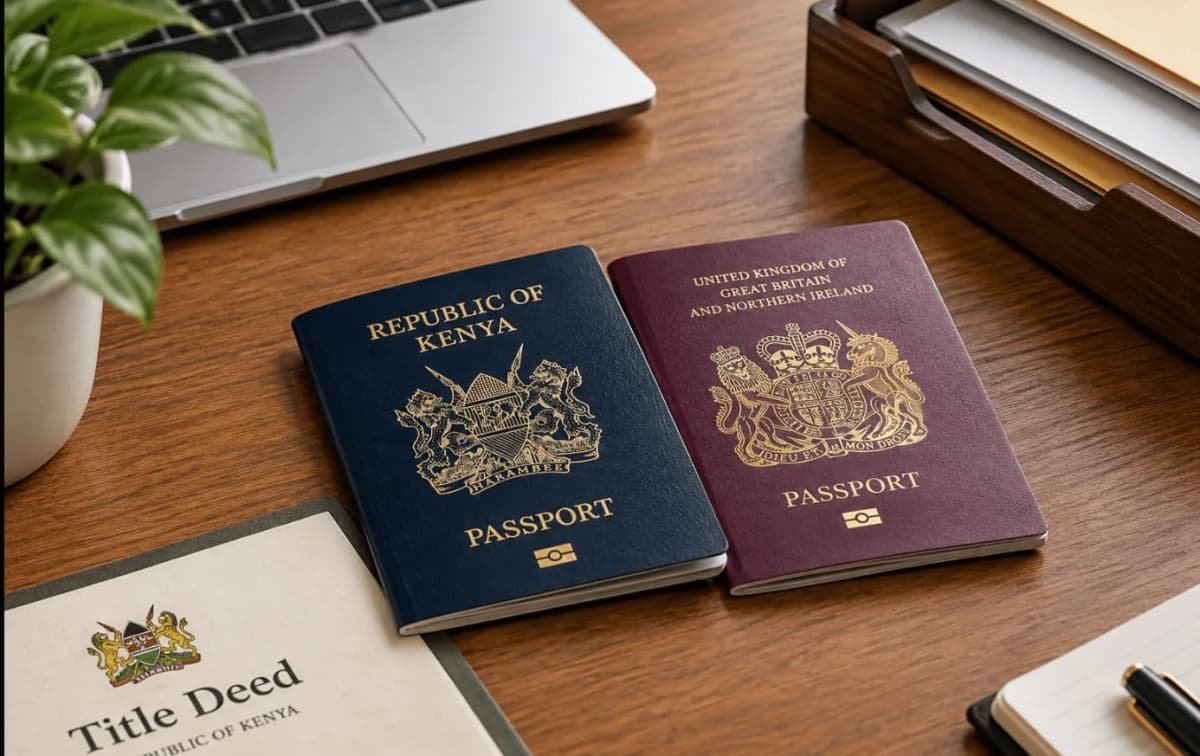
Dual citizenship, the ID, the KRA PIN and Ardhisasa: The order of operations for buying from abroad
In brief Every week someone writes to us from Texas or Berkshire with a version of the same plan. They have found the plot, agreed the price and lined up the money, and they intend to sort out the paperwork of being Kenyan somewhere along the way. The plan fails politely and slowly, because the […]
Kenya has no escrow law: What actually protects your deposit in a property purchase
In brief The question arrives in our inbox in almost the same words every month, usually from abroad. Is there a way to hold the money safely while the deal goes through? Behind it sits a sensible instinct. In the United States and the United Kingdom, a property deposit sits in escrow with a neutral […]