
Real Estate Insights
The law of buying, holding, financing and developing Kenyan land, including the questions diaspora and foreign buyers ask most, answered by the advocates who conduct the transactions.

In short, a commercial lease in Kenya ends in one of two worlds. If the tenancy is controlled under the Landlord and Tenant (Shops, Hotels and Catering Establishments) Act, Cap 301, which it is whenever the lease is unwritten, is written for five years or less, or is written for longer but lets the landlord […]

By Peter Maina

In short, Kenya has no off-plan statute and no escrow law, which means the developer who sells units before they exist is regulated by a patchwork, the Sectional Properties Act, 2020 on what must be handed to a buyer, the county, NEMA and the National Construction Authority on what must be approved before a spade […]
By Peter Maina

In short, an apartment in Kenya is held in one of three ways, and the difference decides what you own, whether a bank will lend on it and whether you will be able to sell it. A sectional title is a registered title to the unit itself and is what you should insist on. A […]
By Peter Maina

In short, a leasehold in Kenya is land held from the national or the county government for a fixed term, and when the term ends the land goes back to the government. It does not renew itself. Section 13 of the Land Act, 2012 and the Land (Extension and Renewal of Leases) Rules, 2017 give […]
By Peter Maina
In short, the Sectional Properties Act, 2020 gave the owners of every registered long-term sublease over an apartment, flat, maisonette, townhouse or office two years from 28 December 2020 to convert it into a sectional title, and the two years ran out on 28 December 2022 with no extension. An unconverted sublease is not void […]
By Peter Maina

In short, a joint venture between a landowner and a developer is the commonest way a plot in Nairobi becomes a block of apartments, and the commonest way a landowner ends up in the Environment and Land Court. The landowner contributes the land, the developer contributes the money and the building, and the landowner is […]
By Peter Maina

In short, land you paid for which is registered in a relative’s name is, on the face of the register, the relative’s land. But the law recognises a trust in your favour where you supplied the money, a trust is an overriding interest which registration does not extinguish, and the Environment and Land Court declares […]
By Peter Maina

In short, a buyer in Kenya should budget between six and seven percent of the purchase price on top of the price itself. Stamp duty at 4 percent in the towns and 2 percent in the countryside is the largest item, the advocate’s fee is set by a published scale which starts at 2 percent […]
By Peter Maina
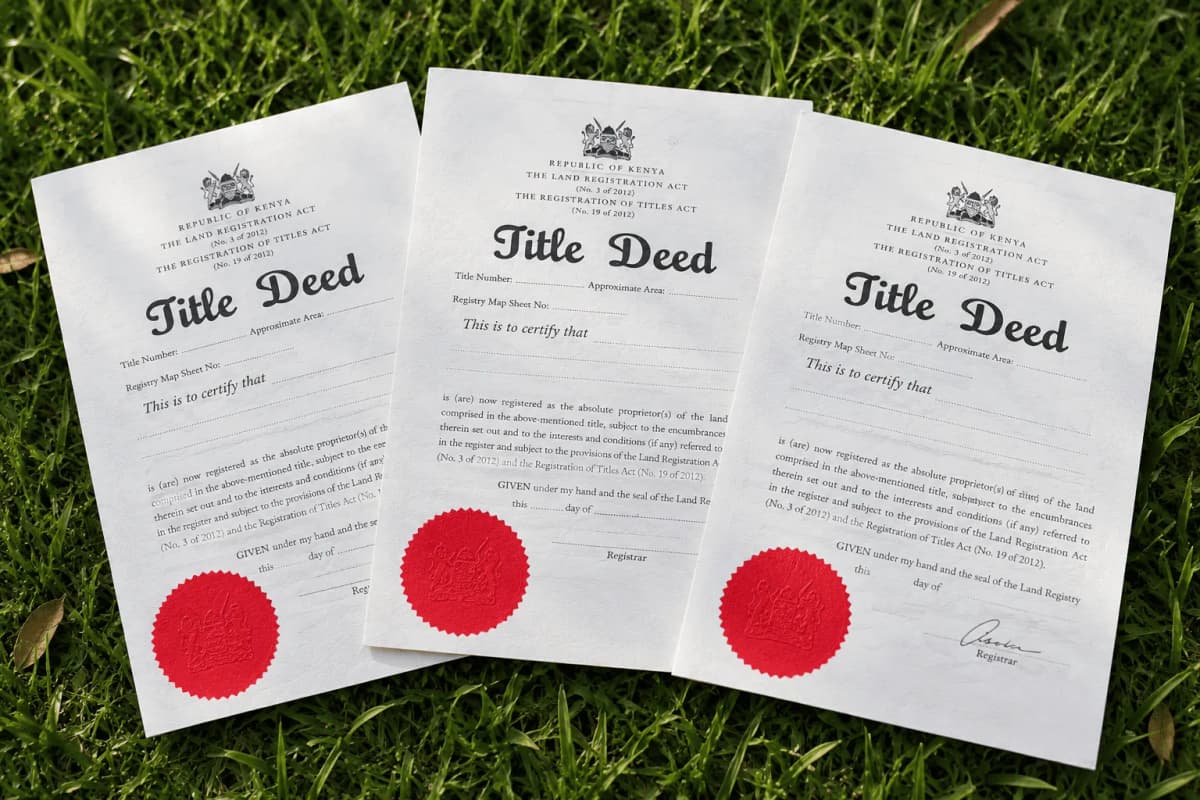
In short, a title deed in a seller’s hand proves almost nothing on its own. What proves ownership is the register at the land registry, the parcel file behind it, the map, the ground and the person, checked in this order and before any money changes hands. This article sets out the seven checks we […]
By Peter Maina

In short, an official land search is the one document which tells you who owns a parcel today and what is registered against it, and for Nairobi and the counties which have moved onto Ardhisasa it is applied for online, costs a few hundred shillings and comes back within a day once the owner consents. […]
By Peter Maina